Dead Reckoning: How the Skull Grave Tee Taps Into Graphic Design's Most Enduring Obsession
What is the cultural significance of skull graphics in streetwear?
There's a reason the skull never goes away. Designers keep returning to it not because it's edgy or provocative, but because it's honest. It's one of the oldest visual shorthand symbols in human culture — a mark that cuts across language, era, and geography. You don't need context to read it. You just know.
Street culture understood this long before fashion did. Before luxury houses started slapping crossbones on everything, the skull was living on hand-painted boards, on patches sewn into denim jackets, on the covers of records that mattered. It wasn't decoration. It was a declaration.
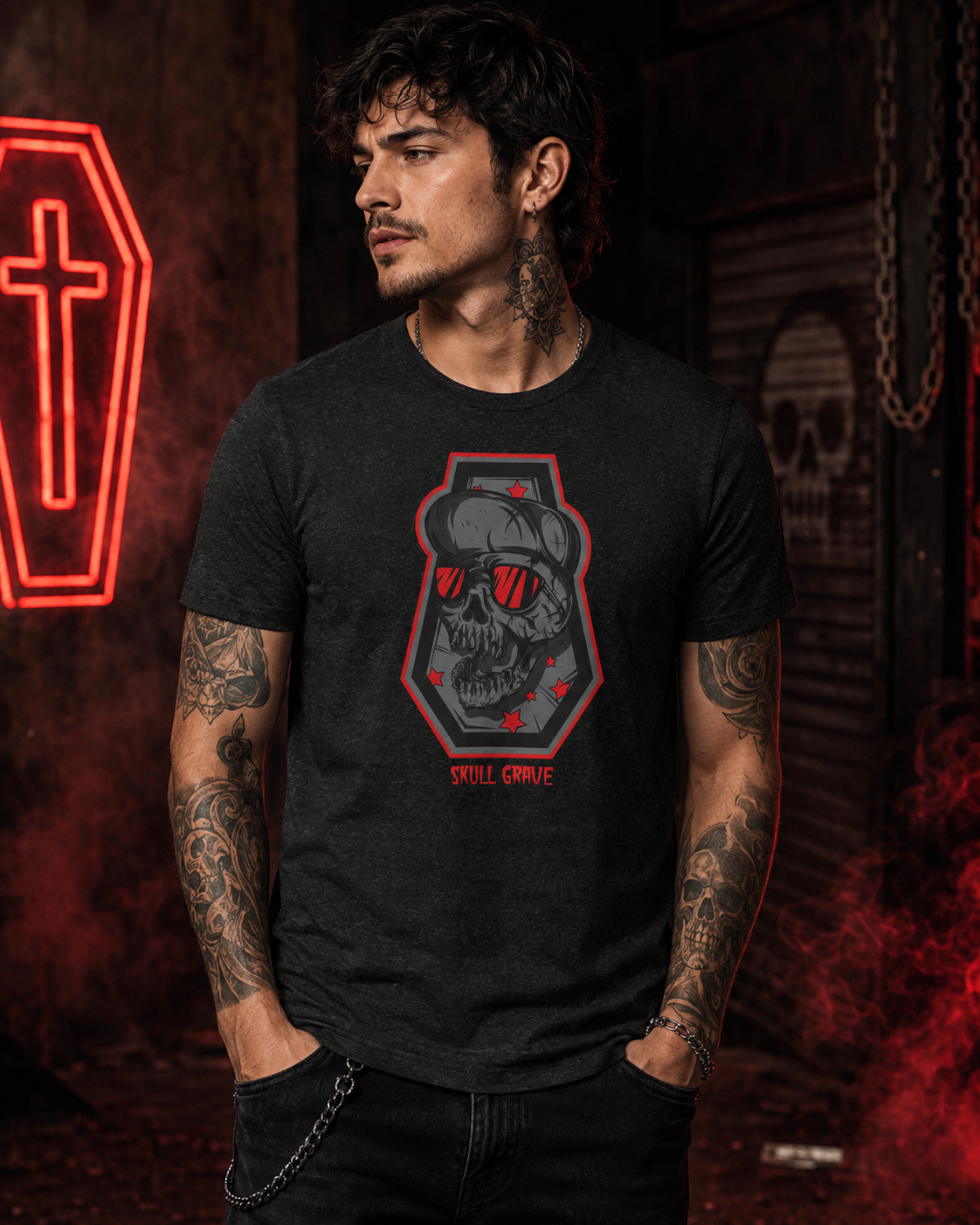
The Skull Grave Tee enters that conversation with confidence. This isn't gothic tourism or seasonal trend-chasing. It's a piece that understands the weight of the image it's carrying — and wears it accordingly.
The Graphic and What It's Actually Saying
Good graphic design doesn't explain itself. The best prints work the way a good album cover works — you feel the tone before you've processed the detail. The Skull Grave Tee operates exactly like that. The composition centres around the relationship between the skull and the grave, two symbols that have always been in dialogue but rarely get placed together with this kind of directness.
In design history, the skull-and-grave pairing goes back further than most people realise. Sixteenth and seventeenth century European printmakers used it as a contemplative device — a visual reminder that time moves in one direction. But what street culture did with that imagery was flip the emotional register entirely. Instead of fear or mourning, the graphic became about defiance. About standing at the edge of something and not flinching.
The T49 interpretation keeps that tension alive. There's a rawness to the artwork that feels deliberate — not rough because it was rushed, but rough because polish would kill the energy. The best skull graphics in streetwear have always had that quality. Think of the early Futura work, or the way Raymond Pettibon's drawings moved off record sleeves and onto walls. The line between fine art, underground print culture, and what ends up on a t-shirt is thinner than most people admit.
Roots in the Underground
To understand where the Skull Grave Tee sits culturally, you have to trace the skull's journey through the underground. It arrived in skateboarding in the late seventies and early eighties not as a marketing concept but as an authentic visual language pulled from biker culture, punk record sleeves, and horror comics. Those early Santa Cruz and Powell-Peralta graphics weren't designed by committees. They came from artists who were themselves part of the scene — people like VCJ and Pushead, who brought an illustrative intensity that changed what graphics on wearable objects could look like.
From there, the image migrated. Into hardcore. Into the early rave era, where it took on a different kind of charge. Into hip-hop, where it appeared on chains, on album art, on the custom leather jackets that guys would get made on Canal Street. The skull was never owned by one subculture. It was borrowed, reinterpreted, and handed forward — and that's exactly why it still resonates.
The Skull Grave Tee doesn't try to claim allegiance to just one of those threads. It carries the memory of all of them. Wearing it feels less like a statement about who you are and more like a signal that you know where the image has been.
The T-Shirt as a Graphic Object
There's a tendency in certain corners of fashion to treat the t-shirt as a lesser garment — a canvas for something else, a base layer, a throwaway. T49's entire premise argues the opposite. The t-shirt is the graphic object. It's the most democratic format in the history of wearable design, and that's not a limitation — that's the point.
The Skull Grave Tee is built with that understanding baked in. The weight and construction of the fabric gives the graphic the right surface to work on — enough structure to hold the print cleanly, enough softness to move properly when you're actually living in it. These details matter because the relationship between a graphic and its substrate is a real design consideration. A heavy-handed print on a flimsy blank feels wrong. A subtle artwork on too stiff a fabric loses its life. The balance here is right.
Sizing runs from XS through to 5XL, which matters more than it might seem. Graphic tees have historically been cut for a narrow range of bodies, which is its own kind of cultural exclusion. Offering the full range is less a commercial decision and more a design one — the graphic should be accessible to whoever wants to wear it.
Priced to Be Worn, Not Preserved
At £20, the Skull Grave Tee sits in interesting territory. It's not disposable, but it's not precious either. That's a deliberate position. The best pieces in streetwear history were never the expensive ones — they were the ones that got worn until they fell apart, that got thrown in bags and taken to shows and washed a hundred times and still looked like they meant something.
There's a version of graphic design culture that fetishises rarity and price point, and that version has always been a bit suspicious. The underground didn't care about resale value. It cared about whether the thing was real. The Skull Grave Tee, priced the way it is, made from materials that justify it, is asking to be worn — not stored.
That's the most punk thing about it.
The Skull Grave Tee is available now in the T49 collection.
The Skull Grave Tee is available now in the T49 collection, in sizes XS through 5XL at £20. EXPLORE THE COLLECTION →