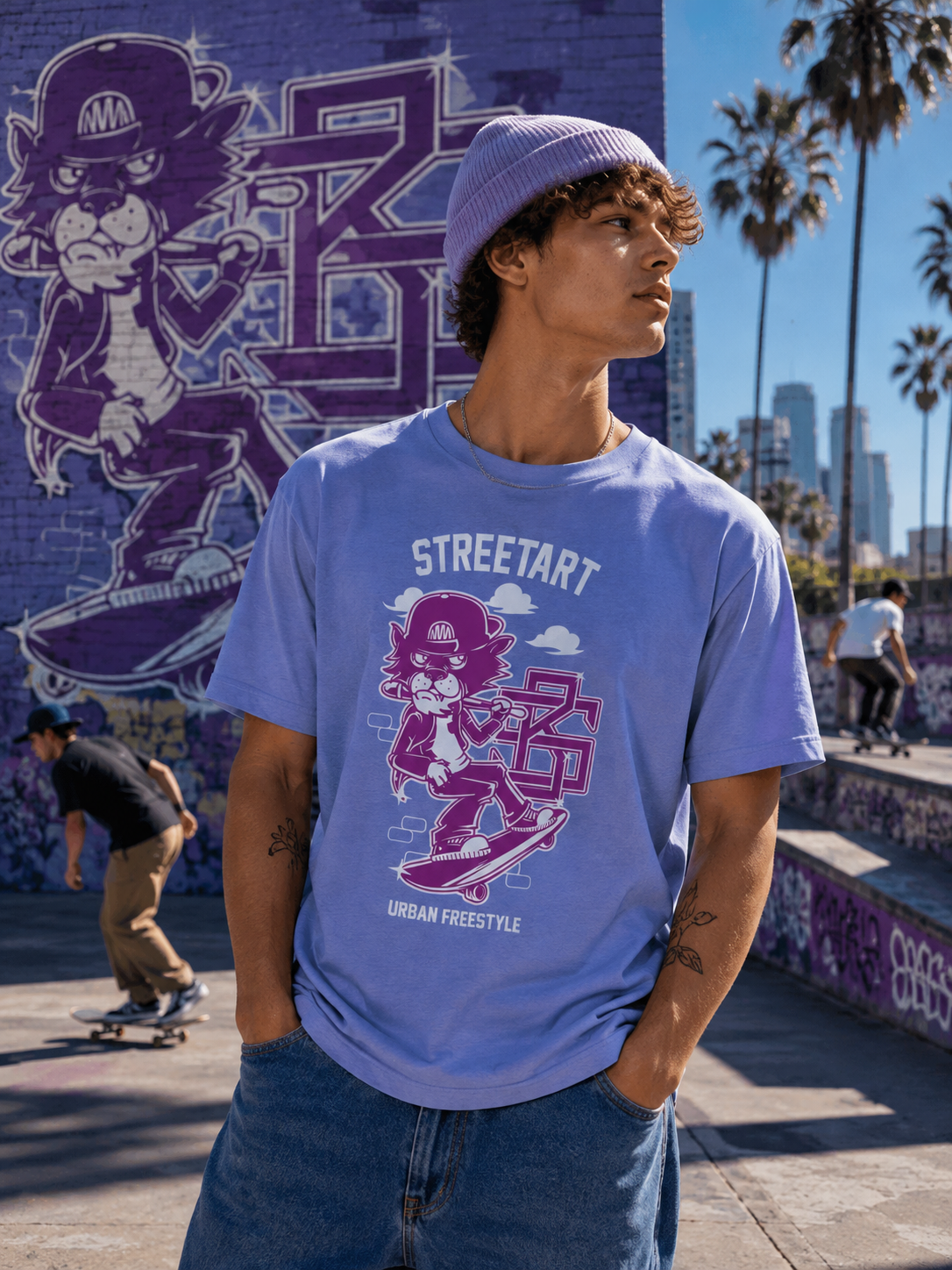
Walls to Wardrobe: How the StreetArt Tee Brings the City's Best Gallery Indoors
What makes a street art t-shirt authentic to the culture?
There's a reason people travel across cities to photograph a mural. It's not tourism — it's a kind of pilgrimage. Street art operates outside the systems that decide what counts as culture. It shows up uninvited, speaks without permission, and disappears overnight. That tension — between permanence and impermanence, between visibility and erasure — is exactly what makes it one of the most compelling visual languages of the last fifty years.
The T49 StreetArt Tee isn't trying to replicate that experience. It's responding to it. There's a difference. Where replication flattens meaning, response adds a layer — a conversation between the wall and the wearer, between the artist who tagged a Hackney underpass at 3am and the graphic tradition that made that tag legible in the first place.
This is a piece built on reference, texture, and an honest relationship with the culture it draws from. Here's how it comes together.
The Graphic Language Behind the Design
Street art has always borrowed freely — from sign painting, from propaganda posters, from comic book lettering, from the kind of hand-rendered type you used to see on fishmongers' chalkboards and boxing gym windows. It's a collage tradition, pulling from wherever it finds something worth using.
The StreetArt Tee works in that same spirit. The graphic sits in that space between controlled design and something that looks like it happened fast, with intent, and without apology. There's a looseness to it that graphic design purists might clock immediately — a deliberate roughness that signals handmade over algorithmic, human over generated.
Think of the visual vocabulary of early 2000s New York and London street culture: the sticker campaigns, the paste-ups, the screenprinted zines that got passed around record shops and skate stores before anyone thought to put them online. The StreetArt Tee is fluent in that language without being nostalgic about it. It's not a heritage piece — it's a piece that knows its heritage.
Where the Street Meets the T-Shirt
The t-shirt has been the canvas of street culture since at least the 1970s. Before there was merch, before there was a model for selling cultural identity as a product, people were wearing their affiliations on their chests — neighbourhood, crew, sound system, block. The graphic tee was always a form of communication, not consumption.
That lineage matters when you're looking at something like the StreetArt Tee. It situates itself within a tradition of wearable graphics that carries actual weight — not the manufactured weight of a fashion campaign, but the organic weight of a culture that built its own visual identity from scratch, outside of any industry's approval.
London in particular has a complicated and rich relationship with street art as identity. From the stencil work that started appearing on Shoreditch walls in the early 2000s to the commissioned murals that now cover entire Brixton facades, the visual language of the street has always been in dialogue with the people moving through those spaces. The StreetArt Tee feels at home in that conversation — not as a tourist's souvenir, but as something a person who actually moves through those spaces would reach for.
There's also something worth saying about wearability as activism — or at least, as declaration. Street art makes the city a site of speech. Wearing that visual language extends that speech into new spaces: the commute, the corner shop, the gathering. The tee becomes mobile in a way the wall can never be.
Construction and Fabric — The Part That Actually Matters
None of the cultural weight carries through if the physical object doesn't hold up. A great graphic on a flimsy shell is a waste of everyone's time. T49 doesn't cut corners on the material side, and the StreetArt Tee is built accordingly.
The cotton here has that mid-weight feel that serious graphic tee buyers tend to gravitate towards — substantial enough to give structure to the print, light enough to actually wear in the range of conditions a British wardrobe demands. It sits on the body without clinging, drapes without collapsing, and holds its shape wash after wash in the way that cheaper alternatives tend not to.
The print itself is executed with a clarity that rewards close attention. Details in the graphic that might read as background noise from a distance resolve into something more considered when you look properly — lines that reference the layered, wheat-pasted aesthetic of street murals, tonal shifts that evoke the way paint bleeds into concrete. It's the kind of thing where the execution has to match the concept, and here, it does.
Sizing runs from S through to 2XL, which in practice means it works across a genuine range of fits and silhouettes. Worn slightly oversized it carries a different energy than fitted — both read, both work, which is exactly how a graphic tee should function.
Why This Piece, Right Now
There's a moment happening in streetwear where the loudest voices — the biggest logos, the most aggressively branded pieces — are starting to feel exhausting. The reaction, predictably, is moving towards graphics that have something to say beyond the name of the label stitched across the chest.
The StreetArt Tee lands in that space deliberately. It's a piece with visual content, with references worth unpacking, with a design that doesn't hand you the meaning pre-packaged but asks you to bring something to it. That's how the best street art works too — the image is there, fixed to the wall, but what it means shifts depending on who's standing in front of it.
At £20, it also sits at a price point that doesn't require justification. This isn't a piece you have to convince yourself about. It's a piece you just wear.
The StreetArt Tee is available now in the T49 collection, in sizes S through 2XL.
The StreetArt Tee is available now in the T49 collection, sized S through 2XL at £20. EXPLORE THE COLLECTION →