Let The Tee Talk: How To Pair A Loud Print With Quiet Pieces
There's a particular kind of outfit failure that's easy to stumble into with graphic tees. You've got a strong print — something with real visual weight, a dense illustration or a dark, mythological figure — and instead of letting it breathe, you pile on. Another pattern here, a heavy logo there, a busy pair of trousers for company. The result isn't bold. It's just noise.
The better instinct, and the one that separates genuinely considered streetwear from an accidental costume, is restraint. When the tee is loud, the rest of the outfit earns its place by getting out of the way. That's not a compromise — it's a design principle. The same logic that makes a great poster work (one focal point, clean negative space) applies directly to what you put on in the morning.
This guide is about building outfits around a statement tee. Not suppressing it. Not dressing it down into irrelevance. But giving it the space and the right companions so it can actually land the way it was designed to.
Start With The Tee As The Brief
When designers build a collection around a concept — a myth, an archetype, a piece of visual history — the graphic itself carries that weight. Before you reach for anything else in your wardrobe, look at the tee seriously. What's the colour palette? What's the mood? Dark, heavy imagery suggests something different to a clean line-art print. A dense, high-contrast graphic with deep blacks and sharp detail has a different temperature to a faded, washed-out illustration.
The Dark Myth tee, for example, works in near-monochrome territory — weighty, ancient in feeling, the kind of image that doesn't need context to command attention. The brief for everything around it is simple: don't compete. Read the tee the way you'd read a brief in a design studio. Then dress accordingly.
This also means understanding scale. A large chest graphic that spreads across the body is a full stop. It doesn't need a busy jacket open over it. A smaller, more precise placement print can handle a little more going on around it. Know what you're working with before you pull the second piece.
The Power Of A Single Neutral
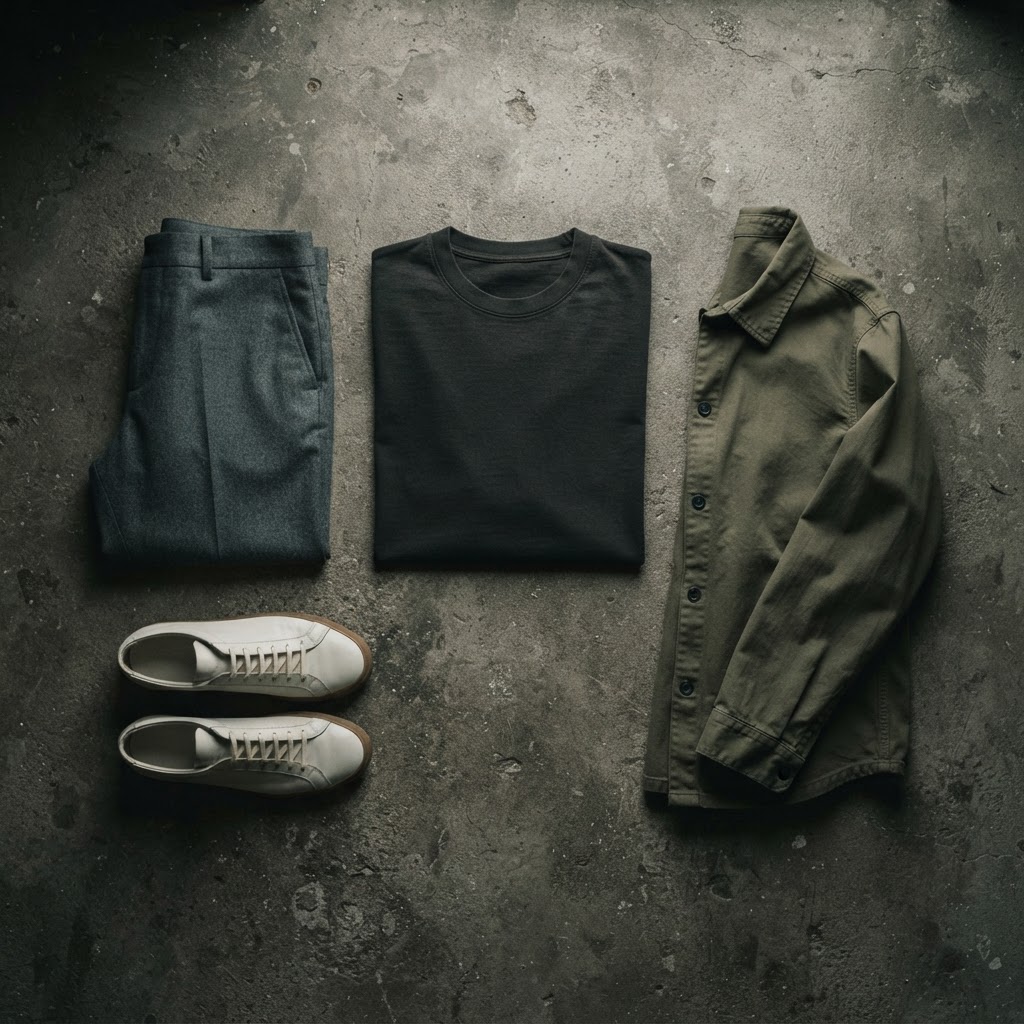
The most reliable move in any loud-tee outfit is the hard neutral. Black, off-white, slate grey, stone, washed khaki — colours that have no agenda of their own. One well-chosen neutral as the foundation piece (trousers, shorts, a long skirt) instantly creates the visual hierarchy the outfit needs. The tee sits at the top. Everything else recedes.
The key is that the neutral has to be genuinely neutral — not a 'neutral' with a heavy texture game or an interesting cut that draws the eye down. A great pair of straight-leg black trousers or wide-leg charcoal cargos does this without asking for attention. The same logic extends to footwear. Clean white trainers or unbranded black boots work because they close the outfit without opening a new conversation.
This sounds simple, and it is — but it's also the thing most people skip. They pick the neutral then undermine it with a busy sole, a contrast stitch detail, or a colour-pop sock. The discipline is committing to the background role all the way down.
Outerwear As Volume Control
A jacket or overshirt worn open over a graphic tee is one of the most common styling decisions in streetwear — and one of the most mishandled. The mistake is choosing outerwear that adds another voice to the conversation. A loud bomber, a heavily branded coach jacket, an overshirt with its own print — these compete directly with what's underneath.
Outerwear over a statement tee should function like a frame, not another painting. An unstructured overshirt in a solid, muted colour — olive, washed navy, pale grey — adds layering depth without visual noise. Worn open so the tee is fully readable, it creates a little context (season, temperature, occasion) without diluting the print.
Heavier options follow the same rule. A clean, unfussy zip-up in a dark neutral, or a structured work jacket in natural cotton, can work well — but the moment the outerwear starts to have its own graphic personality, you've got two pieces fighting for the same space. In that fight, neither wins.
There's also a case for removing outerwear from the equation entirely. Sometimes the strongest version of an outfit built around a bold tee is just the tee, the trousers, and well-chosen footwear. Three pieces, no excess. The confidence in that simplicity is its own kind of loudness.
Proportion Matters More Than Colour
Colour is the obvious variable to manage around a loud print, but proportion is where quieter mistakes get made. An oversized graphic tee — the kind with a real presence on the body — worn with similarly oversized, heavily draped trousers can create a shapeless mass that swallows the print entirely. The graphic disappears into the volume.
A useful counter-move is deliberate contrast in silhouette. Wide-leg or relaxed trousers with a more fitted tee creates a clear visual split. A longer, more structured tee with a slimmer trouser leg gives the print real estate without losing the body completely. These aren't fashion rules in any rigid sense — they're design thinking applied to proportion, the same way you'd balance elements on a page.
Footwear height and weight also play into this. A chunky sole adds visual mass at the bottom of the outfit, which can ground a heavy print or tip an already-busy look into overload. Lean, low-profile trainers keep the weight of the outfit in the tee, where you want it. Read the full silhouette before you finalise anything.
Accessories: Less Is A Position, Not A Default
There's a version of this advice that says: no accessories with a loud tee. That's too blunt. The more accurate position is that accessories with a statement print need to be chosen with a surgeon's precision, not grabbed from habit.
A single, well-considered piece can work — a plain chain in a metal that echoes the tee's palette, a minimal cap in a solid colour, a clean canvas tote that doesn't shout. What doesn't work is the full set: chain, rings, a cap, a bag with its own branding, a watch that catches the light every thirty seconds. That's not accessorising, it's interference.
The question to ask with each piece is: does this add to the outfit or does it add to the noise? If you can't answer that clearly, leave it out. The confidence of a well-built outfit is often in what's absent.
Dressing For Context Without Losing The Tee
A bold graphic tee isn't inherently casual. That idea — that prints only belong in specific, informal contexts — is a leftover from an era when graphic clothing wasn't taken seriously as design. It doesn't hold now, and it's worth pushing back on.
A statement tee worn with well-cut tailored trousers and leather shoes occupies genuinely interesting territory. The graphic sits in contrast to the formality of the cut, and that tension is the point — it's deliberate, not accidental. The key is that every other element has to be immaculate. The trousers need a precise break, the shoes need to be clean, the tee itself needs to be in good shape. Graphic-with-tailoring works when it looks considered. It fails when it looks like you didn't know what you were doing.
In more relaxed contexts, the same principle applies differently. The tee is still the centrepiece — the jeans, the shorts, the joggers around it exist to support that, not to compete. Season and setting change the specific pieces, but the logic stays constant: one voice at full volume, everything else turned down.
The underlying skill in building any outfit around a loud tee is the same skill behind making anything in design work: knowing where to put the attention, and knowing how to protect it once it's there. The tee earns its place by carrying the concept. Your job is to give it room to do that.
From the Collection
The Dark Myth Unisex t-shirt is a strong starting point for this kind of outfit — available now at /product/453722392.
Explore the drop →