Ink on Cotton: The Long, Restless History of the Graphic Tee
There is no garment more democratic, more charged, or more consistently underestimated than the graphic tee. It costs less than almost anything else in your wardrobe. It requires no tailoring, no particular body type, no occasion. And yet, worn right — or worn with the right image — it can communicate more than a full outfit of considered pieces ever could.
The graphic tee is a broadcast. It is a flag, a handshake, a provocation. It is the garment that punk borrowed, that hip-hop weaponised, that high fashion eventually came crawling to. Understanding where it came from is understanding something fundamental about how street culture actually works — not as trend cycles, but as a continuous conversation between image, identity, and cloth.
This is that story.
Before the Graphic: The T-Shirt as Utility Object
The modern t-shirt — that simple, short-sleeved, crew-neck tube of cotton — is a military invention. It entered the American wardrobe as standard-issue underwear during the First World War, distributed to US Navy personnel as a practical underlayer. For decades it remained exactly that: invisible, functional, the thing you wore beneath the thing you wore.
The cultural shift began quietly after the Second World War, when Marlon Brando wore one on screen in *A Streetcar Named Desire* (1951), followed by James Dean in *Rebel Without a Cause* (1955). Suddenly the t-shirt was no longer underwear — it was attitude. It was youth pushing back against the buttoned-up formality of the postwar mainstream. It was still blank, but it was loaded.
The jump from blank to graphic was both technological and political. Screen printing — the process of forcing ink through a mesh stencil onto fabric — had existed since the early twentieth century, but it was slow, expensive, and rarely applied to garments. By the late 1950s and into the 1960s, advances in plastisol inks and automatic printing equipment made garment screen printing cheap enough to scale. The infrastructure was ready. Culture provided the spark.
The 1960s and 70s: When the Tee Became a Medium
The first major wave of graphic tees arrived not from fashion but from politics and music. The 1960s counterculture understood instinctively that a printed shirt was a portable billboard — a way to carry a message into public space on the most visible possible surface: your own body.
By the late 1960s, band tees had begun their long reign. Concert merchandise, initially crude and functional, quickly became identity objects. To wear a Grateful Dead or Rolling Stones tee was not merely to signal musical taste — it was to declare allegiance to a whole set of values, aesthetics, and social affiliations. The garment did the talking.
In the 1970s, the graphic tee absorbed the visual language of the moment: psychedelia, iron-on transfers, collegiate typography, custom airbrushing. It was during this era that the personalised tee culture — getting your name, your car, your city airbrushed onto a shirt at a fairground — became a genuine phenomenon. The graphic tee was democratic in the truest sense: anyone could put anything on it.
Punk, Hip-Hop, and the Politics of the Printed Shirt
If the 1960s established the graphic tee as counterculture currency, the late 1970s and 1980s turned it into something sharper and more self-aware. Punk, arriving from the UK and New York simultaneously, weaponised the graphic tee. Vivienne Westwood and Malcolm McLaren's SEX boutique on the King's Road produced shirts that were deliberately confrontational — images and slogans designed to offend, provoke, and disrupt. The garment was no longer just a signal; it was an act.
Hip-hop, emerging from the Bronx in the same period, developed a parallel but distinct relationship with the graphic tee. In hip-hop's early visual culture, the tee was part of a complete aesthetic system — oversized, bold, paired with tracksuits or Levi's, worn as an expression of neighbourhood identity. Custom tees bearing crew names, RIP tributes, and hand-drawn graphics were central to the culture long before it had mainstream visibility.
By the late 1980s and early 1990s, streetwear as a distinct category was beginning to cohere on both coasts. Shawn Stussy's scrawled signature on board shorts and tees in Laguna Beach. James Jebbia's Union store in downtown Manhattan. Hiroshi Fujiwara importing American street aesthetics to Tokyo and sending them back transformed. The graphic tee was the common thread through all of it — the one garment every scene agreed on.
The 1990s: Logo Culture and the Graphic Tee's Commercial Peak
The 1990s were the decade in which the graphic tee went fully mainstream, and in doing so, created a tension that still defines the category today. As hip-hop's visibility exploded — through MTV, through film, through the emergence of major rap labels — the visual codes of street culture became enormously commercially attractive.
Sporting labels that had been peripheral to fashion — Champion, Fila, Tommy Hilfiger — were suddenly central to it, partly because hip-hop artists wore them and partly because the graphic tee's ability to carry a logo or wordmark made branding legible in a new way. The logo tee was the graphic tee stripped to its most commercial essence: pure brand signal, no narrative required.
But alongside the logo explosion, a more considered graphic tee culture was developing. Supreme, founded in 1994, built an entire mythology on the relationship between the graphic tee and limited availability. Stussy's original network — a loose affiliation of stores in different cities, connected by aesthetic rather than corporate structure — had established the blueprint for independent streetwear. The graphic tee was the core product in almost every case, because it was the most direct way to put an image into the world.
Artists and designers began treating the tee as a genuine canvas. Japanese streetwear brands like BAPE, Undercover, and Neighborhood brought a graphic design seriousness to the garment that elevated it beyond merch or branding into something closer to wearable art. The conversation between American streetwear and Japanese street culture — each reinterpreting the other's references — produced some of the most interesting graphic design work of the decade.
The 2000s to Now: From Subculture to Museum Piece
The graphic tee's journey into high fashion was, depending on your perspective, either an inevitable coronation or a prolonged act of colonisation. By the mid-2000s, luxury houses were paying serious attention. Raf Simons had been referencing punk and post-punk graphics in his collections since the late 1990s. By the 2010s, the oversized graphic tee had become a staple of the runway — at Balenciaga, at Vetements, at Off-White.
This created an odd inversion: the garment that had originated as workwear, been adopted by counterculture, and then claimed by street culture, was now being sold for several hundred pounds by luxury houses. The graphic tee had completed the full circuit from utility object to cultural artefact to luxury commodity.
What this trajectory reveals is something important about how design works in street culture. The graphic tee has always been a vehicle — for image, for identity, for allegiance. The specific image matters enormously. A tee with a genuinely considered graphic, one that carries a point of view or an original visual idea, communicates something entirely different from a tee that simply carries a logo or a licensed image.
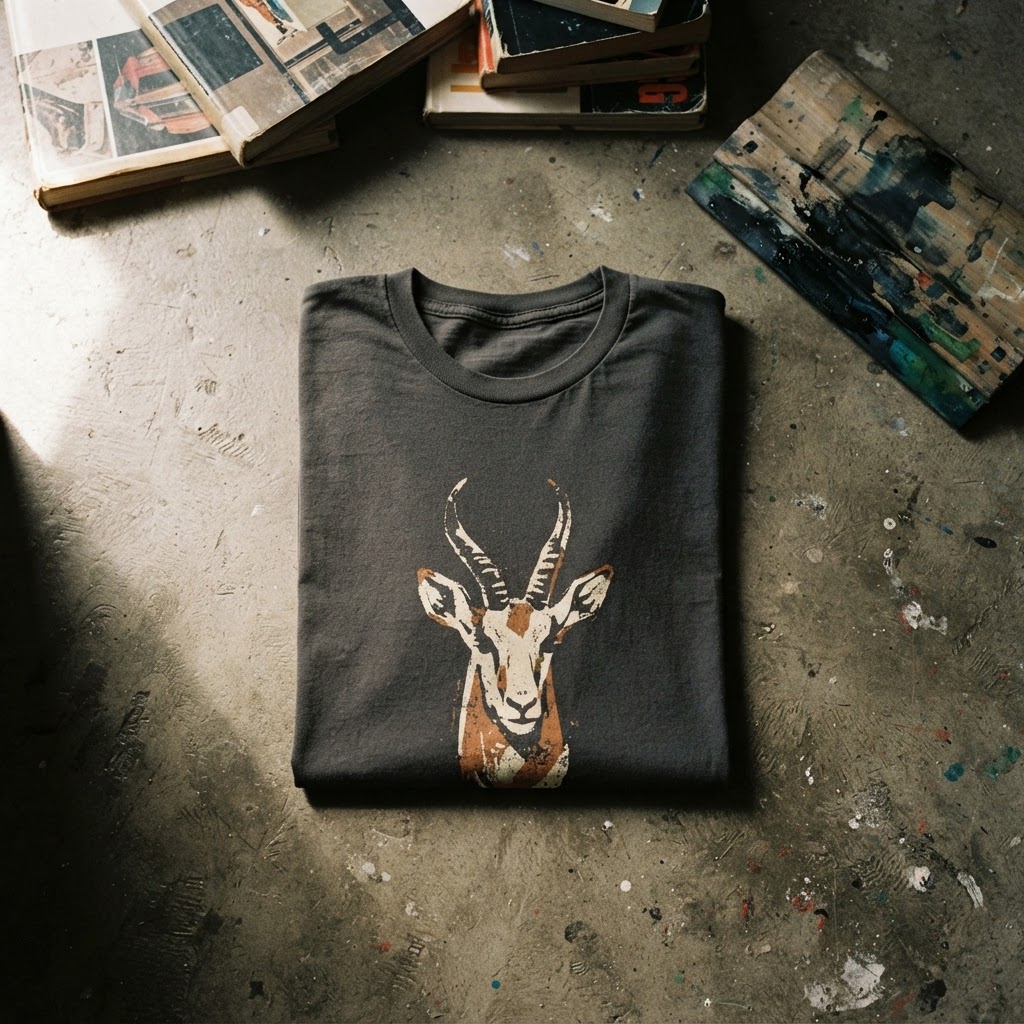
The most enduring graphic tees — the ones that retain their power years or decades after they were made — are the ones where the image is doing real work. Where the design isn't decoration but argument. The Masked Hunter Tee from T49 operates in this tradition: a graphic built around archetype and visual tension, the kind of image that earns its place on the front of a shirt rather than simply occupying it.
Why the Graphic Tee Isn't Going Anywhere
There is a recurring tendency, every few years, for some corner of the fashion press to declare the graphic tee over — replaced by minimalism, or logomania, or whatever the current counter-reaction happens to be. It never sticks. The graphic tee is not a trend. It is a format.
Like the vinyl record or the paperback book, the graphic tee is a delivery mechanism for something more important than itself: an image, an idea, an identity. As long as people want to wear their affiliations, their obsessions, and their aesthetics on their bodies — and they always will — the graphic tee will be there to carry it.
The best graphic tees being made right now share something with the best ones from any era: they begin with a genuine image. Not a licensed property, not a recycled reference, but something that was actually thought about — drawn, composed, considered. That is the standard worth holding to, and it is the only one that produces garments worth keeping.
From the Collection
The Masked Hunter Tee is available now in the T49 collection — /product/459913416
Explore the drop →