The Quiet Power Of A Single Line Design
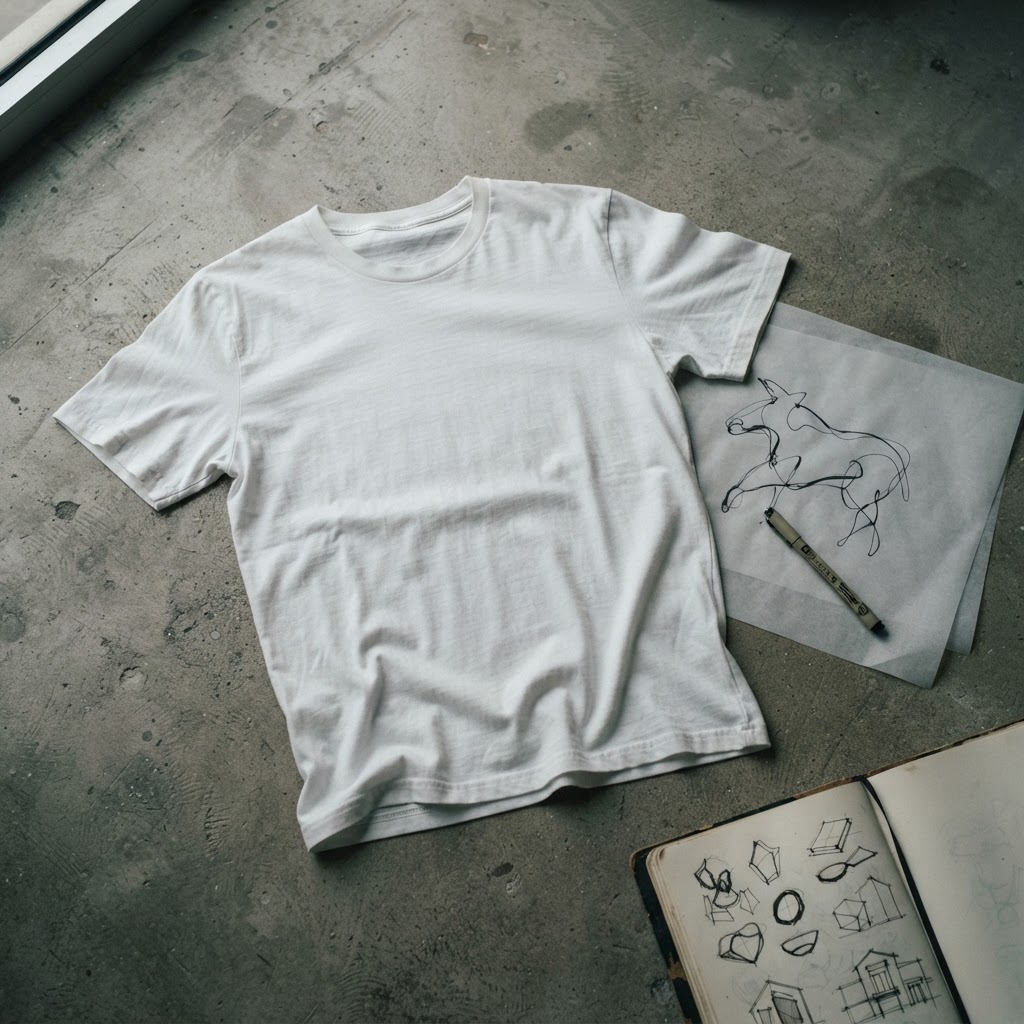
There is a particular kind of confidence that doesn't announce itself. It doesn't need to. It walks into the room, settles, and lets everything else do the talking. In graphic design — and specifically in the culture of the Tee — that confidence has a form: the single line.
Not a logo. Not a slogan. Not a layered composition fighting for attention across a cotton canvas. A single, considered mark. One stroke, one curve, one unbroken gesture that somehow carries more weight than a full illustration ever could. This is not minimalism for the sake of it. This is restraint as an act of will.
Street culture has always had a complex relationship with loudness. From the early days of bootleg prints and oversized tags to the hyper-saturated graphics of the noughties, the instinct was often to go bigger, bolder, more. But running parallel to all of that — quieter, more patient — was another current. One that understood what a single line could do if it was drawn right.
Where The Line Comes From
The single line as a design gesture has roots that stretch far beyond streetwear. Picasso's continuous line drawings. Matisse working with a brush and near-total economy of movement. Saul Bass reducing an entire film's emotional world to a shape and a stroke. These weren't simplifications — they were compressions. The idea was to remove everything that wasn't essential until what remained was pure signal.
Graphic designers working in the late twentieth century brought this thinking into commercial and counter-cultural contexts. Poster art, record sleeves, zine covers — spaces where budget was tight but vision had to be clear. When you can't afford to print four colours, you learn fast what one line is worth. That discipline didn't disappear when budgets grew. It became a philosophy.
Streetwear inherited this. Not consciously, in most cases — culture rarely works that way — but through the influence of skate graphics, punk layouts, and the kind of lo-fi design language that comes from people making things in bedrooms and garages. The constraints produced the aesthetic. And the aesthetic outlasted the constraints.
Why Restraint Is Harder Than It Looks
There is a persistent myth in design that simplicity is easy. That anyone can do less. The reality is the opposite. When you strip everything away, what remains has to be exactly right. There is nowhere to hide. A poorly drawn line in a dense composition gets lost. A poorly drawn line on an empty ground is the whole conversation — and it tells you everything you didn't want to know about the designer's ability.
This is why the single line design, done well, carries such authority. It is proof of control. Of intention. Of a designer who knows precisely what they're doing and has the nerve to show it in its most exposed form. In a culture that often mistakes complexity for quality, that kind of clarity reads as a quiet flex.
It also demands something from the wearer. A loud graphic tells you what to think about it. A single line asks you to bring something to it. There's an openness to it — an invitation to project meaning, to complete the image in your own mind. That is not passivity. That is design working at a more sophisticated frequency.
The Tee As A Canvas For Reduction
No format has proven more interesting for this kind of work than the Tee. Partly for practical reasons — it's a flat plane, a limited ground, an object that moves through the world on a body rather than hanging on a wall. But also because the Tee carries cultural weight that a gallery print does not. It is worn, not displayed. It is chosen daily, not curated for occasion.
That changes how design on it functions. A single line on a Tee is not a museum piece. It is in conversation with jeans, a jacket, a pair of shoes, the posture of the person wearing it, the street they're walking down. It has to work in motion, in context, against other visual noise. The fact that a well-executed single line can hold its ground in all of those conditions — that it can remain legible and resonant while the rest of the world crowds in — is genuinely remarkable.
The best Tee designers understand this. They know they are not designing for a static viewer at a fixed distance. They are designing for glances. For peripheral vision. For the half-second someone has to register what they're looking at before they've passed. A single strong line survives that test. A cluttered composition often doesn't.
The Boarpower Parallel: Animal Energy Through Reduction
It's worth noting how this principle of reduction operates even when a design carries figurative weight. Take a subject as inherently powerful as a boar — an animal loaded with ancient associations of strength, ferocity, and wildness — and ask what happens when you approach it not through hyper-detail or aggressive rendering, but through economy of line. The form doesn't diminish. If anything, it intensifies. When you reduce an icon to its most essential gesture, you're left with pure energy. No visual noise, no fussy crosshatching, no excess. Just the idea of the thing, expressed as directly as possible.
This is the logic that runs beneath the surface of the Boarpower design in the T49 collection — a piece that understands how much force a controlled line can carry. It's a useful example of how the principles discussed here operate in practice: restraint amplifying rather than diluting the subject.
How Streetwear Reads Simplicity As Status
There's a cultural economy to all of this that is worth being honest about. Simplicity, in streetwear, has become its own kind of signal. But not because it's a trend — because it's always been the language of the people who actually know.
The person who doesn't understand fashion reaches for the most recognisable thing, the biggest logo, the most obvious statement. The person who is genuinely fluent can walk into a room wearing almost nothing in terms of visual information and be read immediately by the right people. A single line, placed correctly, speaks that language. It says: I know what I'm doing. I don't need to explain myself.
This is not snobbery. It is the natural logic of any cultural system that has depth. Every subculture develops a shorthand — signs that are legible to insiders and opaque to everyone else. In graphic streetwear, the single line is one of the cleaner expressions of that shorthand. It rewards attention. It doesn't perform for casual viewers.
Designing With Nerve
What does it take to commit to a single line design? In commercial terms, it requires a certain nerve. The instinct in most design processes is to add — another element, another layer of detail, another reference to make the brief feel fully answered. Removing things, and then removing more, until you arrive at something that feels frighteningly sparse, is genuinely difficult. It runs against almost every natural impulse.
But the designers who can do it — who can hold the line, so to speak, and resist the pull toward more — produce work that lasts. There is a reason that the most enduring logos, the most recognisable marks in design history, are almost always the simplest ones. They don't date because they never relied on the particular visual language of their moment. They relied on something more fundamental: the logic of a mark made with intention.
For T49, this thinking is embedded in how the collection approaches design. Not every piece is minimal — the range is deliberately broad, because design culture itself is broad. But the consideration behind each piece, the question of what is necessary and what can be removed, runs through everything. It's the difference between making a graphic and making a statement — not in the hollow marketing sense of that phrase, but in the structural, permanent, quietly powerful sense.
A Tee with one good line on it will be worn differently than one that shouts. It will be worn longer, chosen more deliberately, and carried with a particular kind of ease. That ease is not indifference. It is the confidence of someone who knows exactly what they have on.
From the Collection
The Boarpower Tee is available now in the T49 collection — a piece that puts exactly this kind of considered reduction into practice. [View it here](/product/453548269).
Explore the drop →