
Why Graphic Tees Will Always Outlast the Moment They Were Made In
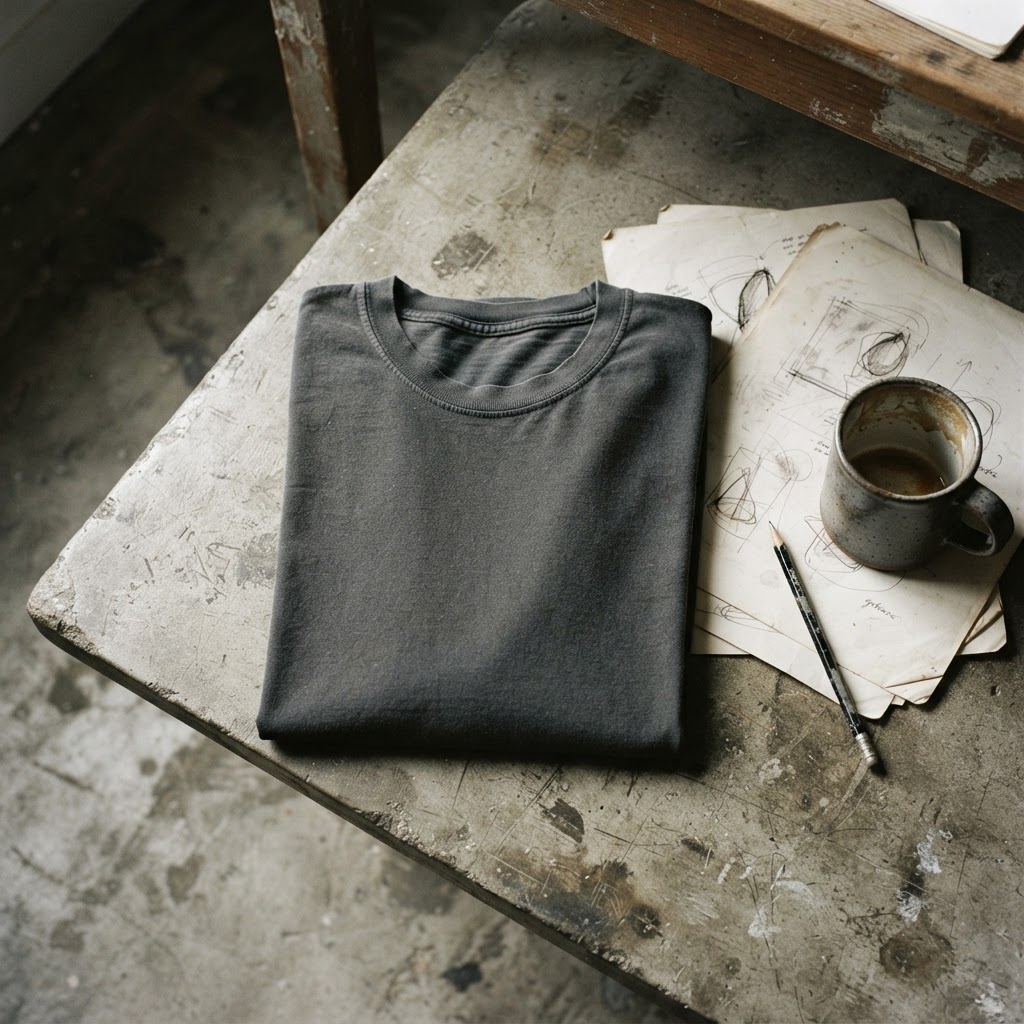
There's a specific kind of gravity that a great graphic tee carries. Not weight in the literal sense — a good cotton tee barely registers — but cultural weight. The kind that makes you stop mid-scroll, or do a double-take on the street. You don't always know why it hits. You just know it does.
Fashion cycles are relentless. What's referenced one season is parody the next. Silhouettes rise and collapse. Colourways go from essential to embarrassing in eighteen months. And yet the graphic tee endures — not as nostalgia, not as irony, but as something genuinely alive. It keeps finding new contexts, new wearers, new reasons to exist.
This isn't an accident. It's design logic. And understanding why the graphic tee refuses to die tells you something important about how clothing actually works — and why some pieces transcend the culture that made them.
The T-Shirt Was Never Really Just a T-Shirt
For most of its early life, the t-shirt was invisible infrastructure. Military undergarment. Factory floor staple. It was the blank beneath everything else, the layer nobody was meant to see. When Marlon Brando wore one in *A Streetcar Named Desire* in 1951, it caused actual controversy. A garment that lived under shirts had been promoted to surface. People weren't ready.
But that promotion — from hidden layer to visible statement — turned out to be irreversible. Once the t-shirt was understood as a canvas, it became one of the most efficient communication tools in the history of clothing. Cheap to produce, easy to distribute, immediately readable. By the late 1960s, political movements had figured this out. By the 1970s, bands were using tour tees to extend their reach into cities they'd never play. By the 1980s, designers were treating the t-shirt with the same seriousness they gave tailoring.
What's remarkable is that none of this erased the garment's democratic character. A tee printed in a basement carries the same format as one sold in a Dover Street boutique. The playing field is the chest. The medium is ink on cotton. What matters is the idea.
Why Graphics Survive When Logos Fade
Brand logos have a peculiar half-life. At peak saturation they feel essential — a shorthand for belonging, taste, aspiration. Then something shifts. The logo becomes too common, or the brand makes a wrong turn, or the cultural moment that gave it meaning simply ends. Suddenly the same chest print that read as cool reads as costume.
Graphic tees built around genuine imagery — illustration, concept, symbol — don't follow that curve. They operate on different logic. A strong graphic isn't borrowing someone else's cultural capital. It *is* the capital. The image does the work. Which means its relevance isn't tied to a brand cycle or a celebrity endorsement or a season's colour palette.
Think about the imagery that keeps surfacing across decades of street culture: animals carrying weight and mythology, figures in motion or conflict, abstract systems that suggest something larger than themselves, human forms stripped to their symbolic essence. These images travel because they speak to something that doesn't expire. Mortality. Identity. Power. Speed. The desire to belong to something worth belonging to.
The *Born Race* design in T49's current collection works this way. The image doesn't explain itself — it doesn't need to. It carries that particular graphic tee quality where the meaning arrives before the analysis does. You feel it before you decode it. That's the mark of an image that will still be relevant in ten years.
The Underground as Design Laboratory
Every major shift in graphic tee culture has come from somewhere that wasn't supposed to matter. Skate decks. Zine covers. Record sleeves for labels nobody outside the city had heard of. The visual language that now defines premium streetwear was developed in conditions that had nothing to do with commercial ambition and everything to do with necessity and obsession.
This is important because it explains why mass-market graphic tees so consistently miss. They're trying to reverse-engineer a sensibility that was never built to be engineered. Underground design has a specific quality — a roughness, a commitment to the idea over the execution, a willingness to be strange — that disappears the moment it's produced with a target demographic in mind.
The best independent t-shirt work still carries this. Not roughness for its own sake, but evidence of actual thinking. You can feel when a design has been worked through — when the image is the result of someone genuinely wrestling with what they wanted to say, not filling a template. That friction is what gives certain graphics their staying power. They're not optimised. They're *decided*.
How Context Transforms the Same Tee
One of the stranger qualities of a great graphic tee is how completely it can shift depending on where it's worn and with what. This isn't just styling flexibility — it's something deeper about how clothes function as social code.
A tee that reads as aggressive worn alone under harsh light becomes considered when layered under a tailored coat. The same image that feels raw paired with workwear reads as deliberate with clean trousers and minimal footwear. The graphic doesn't change. The context re-frames it entirely, the way a painting changes when you move it from a gallery to a domestic wall.
This contextual flexibility is part of why graphic tees keep surfacing across different subcultures. They're not fixed to one reading. A design rooted in one scene can be adopted by another without losing its integrity, because the image carries meaning that transcends its origin. The tee that meant one thing in 1991 means something adjacent but distinct in 2024. That accumulation of context is what makes certain prints feel historic without feeling dated.
What serious wearers understand — and what brands that last have always understood — is that the graphic tee is never a passive object. It generates conversation. It positions the wearer. It carries the memory of where it came from while staying open to where it's going.
The Premium Question
For years, the idea of a premium graphic tee was slightly contradictory. The t-shirt's value came from its accessibility, its classlessness. Expensive cotton and considered construction felt like they were working against the form's essential nature.
That tension has mostly resolved now — not because the t-shirt has become precious, but because what premium means in this context has been redefined. It's not about exclusion or price signalling. It's about the image being worth living with. A garment built properly, from materials that hold their weight and shape, carrying a design that earns attention rather than demanding it.
The shift matters because it changes the relationship between wearer and object. A tee you bought because it was cheap and the graphic was fine gets replaced. A tee you bought because the image genuinely stopped you — and the construction backs up the design — becomes something you keep. That's the graphic tee as long-term wardrobe object, not fast fashion with a print on top.
This is where independent labels have a real advantage. Without the machinery of trend-chasing, the work can be slower and more deliberate. Each image can be considered properly. The question isn't what's selling this season — it's what's worth making.
Why the Graphic Tee Is Always Contemporary
Here's the paradox at the centre of all this: the graphic tee has no definitive era. It doesn't belong to the nineties or the eighties or now. It belongs to every moment in which someone had an image worth sharing and a surface to put it on.
That's not a nostalgic statement. It means the form is genuinely contemporary — always, continuously, because it's responsive to whoever is using it and whatever they need to say. The technology around it changes. The visual languages evolve. The subcultures that drive it shift and splinter and recombine. But the basic equation stays constant: one image, one chest, one person choosing to wear it out into the world.
Trends are built on consensus — the sense that enough people agree this is the moment. The graphic tee doesn't need consensus. It needs conviction. One person making something because it matters to them, and another person recognising something true in it. That's a relationship that survives any trend cycle, because it was never inside one to begin with.
From the Collection
The Born Race Unisex t-shirt is available now at T49 — /product/453554569
Explore the drop →