Red Earth and Resistance: The Apache Warrior Tee That Carries Real Weight
What does an Apache warrior graphic on a t-shirt represent?
There's a particular kind of graphic that stops you mid-scroll. Not because it's loud, or trend-chasing, or engineered for a reaction — but because it carries something. A gravity. The Apache Warrior tee from T49 is that kind of graphic. It doesn't announce itself. It arrives.
At a time when indigenous imagery in fashion has a complicated and frequently embarrassing history — commodified, flattened, stripped of meaning by brands who should have known better — putting an Apache warrior at the centre of a t-shirt design is either a bold act of respect or a careless one. T49's version earns the former. The difference is in the execution, the restraint, and what the image actually communicates when you sit with it.
This isn't a design built around novelty or trend. It's a study in how a single figure, rendered with care, can carry centuries of meaning through a cotton weave.
The Visual Architecture of the Design
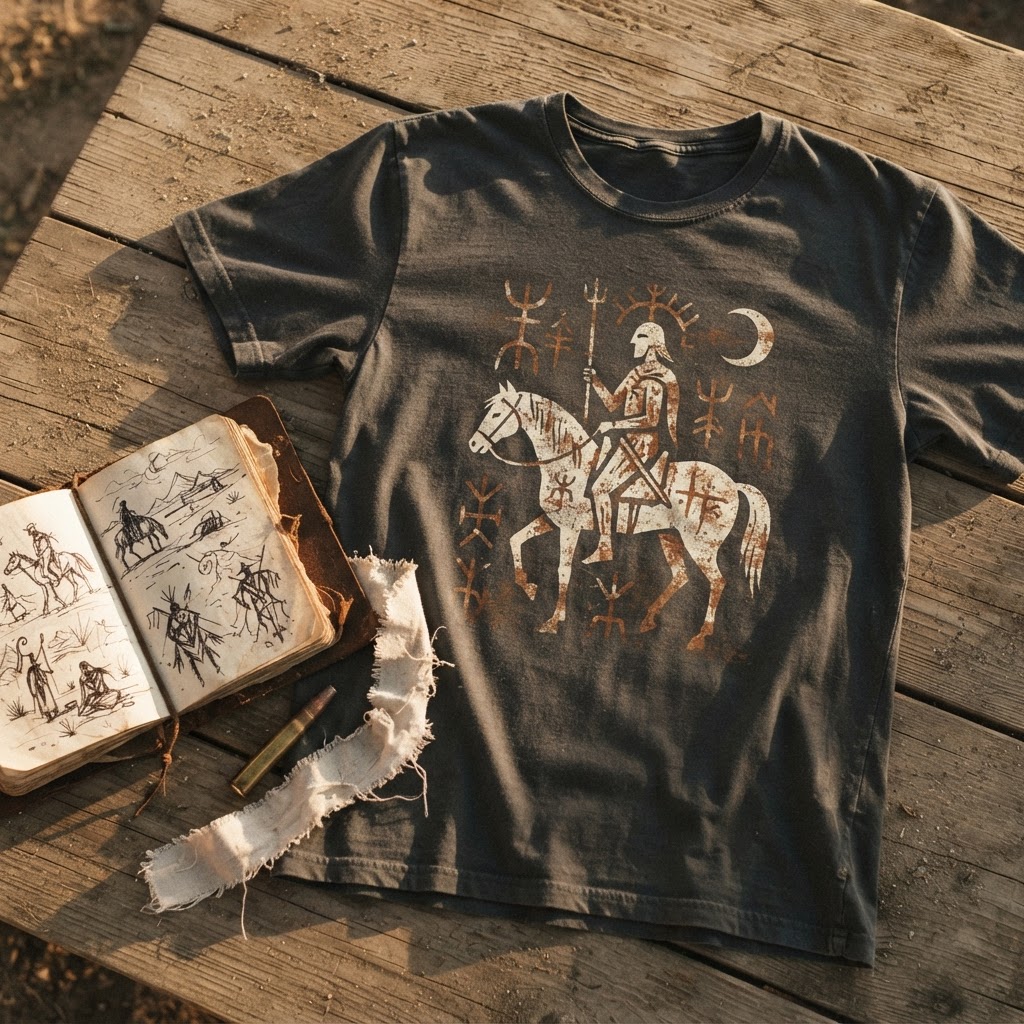
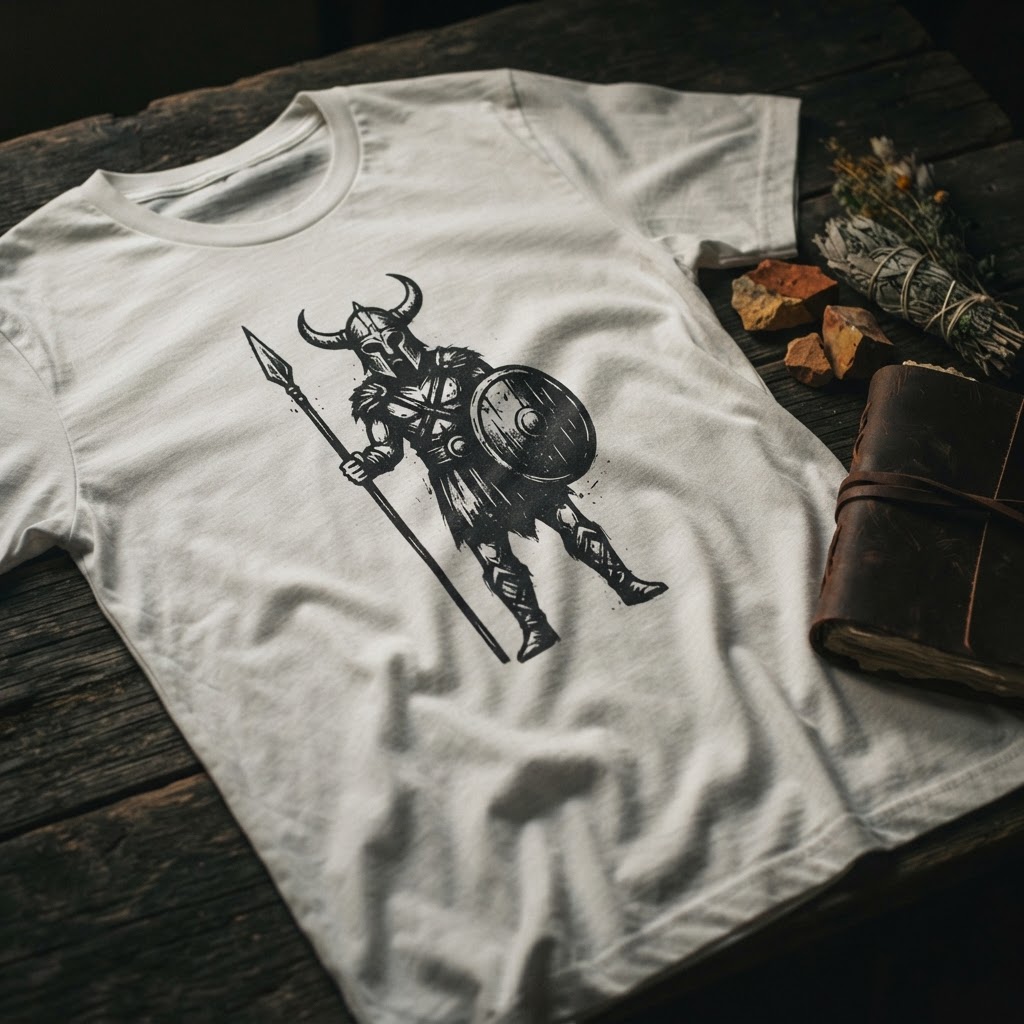
The first thing that strikes you about the Apache Warrior graphic is its compositional discipline. This isn't a scattered, maximalist print trying to fill space. The figure is centred, deliberate, and drawn with the kind of line work that rewards close attention. There's weight in the strokes — not the clean precision of digital vector art, but something with more texture. More history in it.
The warrior is rendered in profile or three-quarter view, which is no accident. This is the angle of monuments, of coins, of portraiture that intends to convey authority and permanence. It's the angle that says: this person existed, this person mattered. The headdress — traditionally worn in ceremony and earned through acts of courage — is depicted with structural accuracy rather than the exaggerated Hollywood caricature that's poisoned so much of this visual territory. The feathers carry weight. The face holds composure.
On a white or neutral cotton ground, the contrast is stark and intentional. Dark ink on pale fabric creates a kind of print archaeology — as if the image has always been there, waiting to surface.
Apache Identity: What the Iconography Actually Means
The Apache were not a monolithic people, and any serious engagement with this imagery has to start there. Comprising multiple groups — Chiricahua, Mescalero, Jicarilla, Western Apache among them — they occupied vast territories across what is now the American Southwest and northern Mexico. Their resistance to Spanish colonisation, and later to the expansion of the United States, lasted longer and proved more tenacious than almost any other indigenous nation in North American history.
Geronimo, arguably the most famous Apache leader, surrendered in 1886 — the last major Native American resistance leader to do so. The name became shorthand for something beyond one man: a defiance so complete it became mythological. U.S. paratroopers would later shout it jumping from planes. NASA named a helicopter project after it. The word passed into language as a synonym for courage so extreme it borders on recklessness.
The Apache warrior in the visual imagination represents something specific: not aggression for its own sake, but the refusal to be erased. That's a different kind of iconography entirely. It's why the image carries weight in contexts far removed from its geographic origin — why it resonates in street culture, in underground art, in spaces that understand resistance as a lived condition rather than a historical footnote.
Why This Works as a T-Shirt Graphic
Not every powerful image translates to print. Scale, detail, and tonal range all behave differently on fabric than they do on screen or paper. A graphic that looks stunning in a digital mockup can lose its soul in production — the mid-tones mudding, the fine lines collapsing into each other, the whole thing becoming a vague impression of what it was meant to be.
The Apache Warrior graphic survives the translation because it was designed for the medium. The line weights are calibrated for cotton — thick enough to hold, fine enough to suggest detail without demanding it. The negative space is used intelligently; the areas where the fabric breathes are as considered as the areas where the ink sits. This is print literacy. It's rarer than it sounds.
There's also something about the horizontal grain of woven cotton that suits this kind of imagery. The slight texture of the fabric gives the print a tactile depth — a quality closer to relief than flat reproduction. The warrior isn't just on the tee. He's in it. That's the difference between a graphic printed on cotton and a graphic designed for cotton.
The Street Culture Lineage of Indigenous Iconography
This isn't the first time Native American imagery has intersected with street and youth culture, and that history is worth acknowledging directly. The 1990s saw a wave of appropriation so casual it barely registered as such at the time — headdresses at festivals, war paint at raves, generic "tribal" prints on everything from windbreakers to trainers. It was lazy, it was harmful, and it set a template that brands are still reckoning with.
But there's a counter-lineage worth recognising too. Within underground art, within certain corners of tattoo culture, within the visual vocabulary of artists who've engaged seriously with indigenous history — Apache and broader Native American iconography has been treated with the weight it deserves. Artists like Shepard Fairey, whose work regularly grapples with resistance and political identity, have drawn on this imagery in ways that centre the subject rather than flatten it. The warrior as icon of defiance rather than costume.
T49's design sits closer to this tradition. The graphic isn't decorative. It isn't nostalgic in a romanticising, soft-focus way. It's confrontational in the quietest possible sense — the way a portrait can confront you by simply refusing to look away.
Wearing Resistance: How the Tee Functions in Context
There's a particular cultural logic to wearing a warrior graphic that has nothing to do with cosplay or fantasy. It's about alignment — about choosing to carry an image that represents something you want to stand adjacent to. Resistance. Endurance. The refusal to be defined by someone else's narrative.
In streetwear, this kind of alignment has a long and legitimate history. The culture has always been interested in figures who operated outside sanctioned structures — outlaws, revolutionaries, subcultures, countercultural movements. The Apache warrior fits this lineage not because he's exotic or other, but because the historical reality of what he represents — fighting to maintain identity and territory against an overwhelming expansionist force — maps cleanly onto experiences that resonate across cultures and geographies.
Worn with dark denim and work boots, the tee reads as something considered, almost austere. Worn under an open overshirt, the graphic becomes a flash of depth beneath casual layering. The design has enough authority that it doesn't need context to communicate — but it rewards the wearer who brings some.
The Case for Figurative Prints in 2024
Abstraction has dominated premium graphic tee culture for the better part of a decade. Geometric forms, wordmarks, deconstructed logos — the move away from figurative imagery felt, for a while, like a natural evolution. More sophisticated. Less literal.
But there's been a quiet reversal. Figurative prints — faces, figures, portraits — have been returning to the front of the conversation, partly as a reaction to the coldness of pure abstraction, and partly because the cultural moment calls for images with human weight. People want to wear something that means something, not just something that looks like it might.
The Apache Warrior tee is figurative in the fullest sense. There's a person here, with presence and history. That presence is what makes it worth putting on your body — not just on your wall or your screen. Cotton is intimate. What you print on it should be able to hold that intimacy without collapsing under it.
This design can.
The Apache Warrior Unisex t-shirt is available now at T49 — /product/453549291 EXPLORE THE COLLECTION →