Line Work and Restraint: Three Ways to Wear a Minimal Warrior Tee
How do you style a minimal line-design graphic tee?
There's a particular discipline involved in wearing a tee that leads with line rather than colour. No heavy fills, no aggressive typography, no palette doing the heavy lifting — just the confidence of a well-drawn form holding its own against whatever you put around it. That restraint is harder to pull off in design than it looks, and it asks something similar of the person wearing it.
Minimal line-design tees occupy a specific space in the graphic tee canon. They're not quiet — the subject matter often isn't, and the Apache Warrior Unisex t-shirt from T49 is a good example of this — but the visual language is controlled. A single-colour illustration built from deliberate line work, carrying real weight without filling every centimetre of the garment with noise. The design communicates through economy, not volume.
That changes how you style it. You're not building an outfit around a focal point that demands distance — you're integrating something more considered into a broader visual argument. The three approaches below are practical starting points, each built around a different intent.
One: The Clean Stack
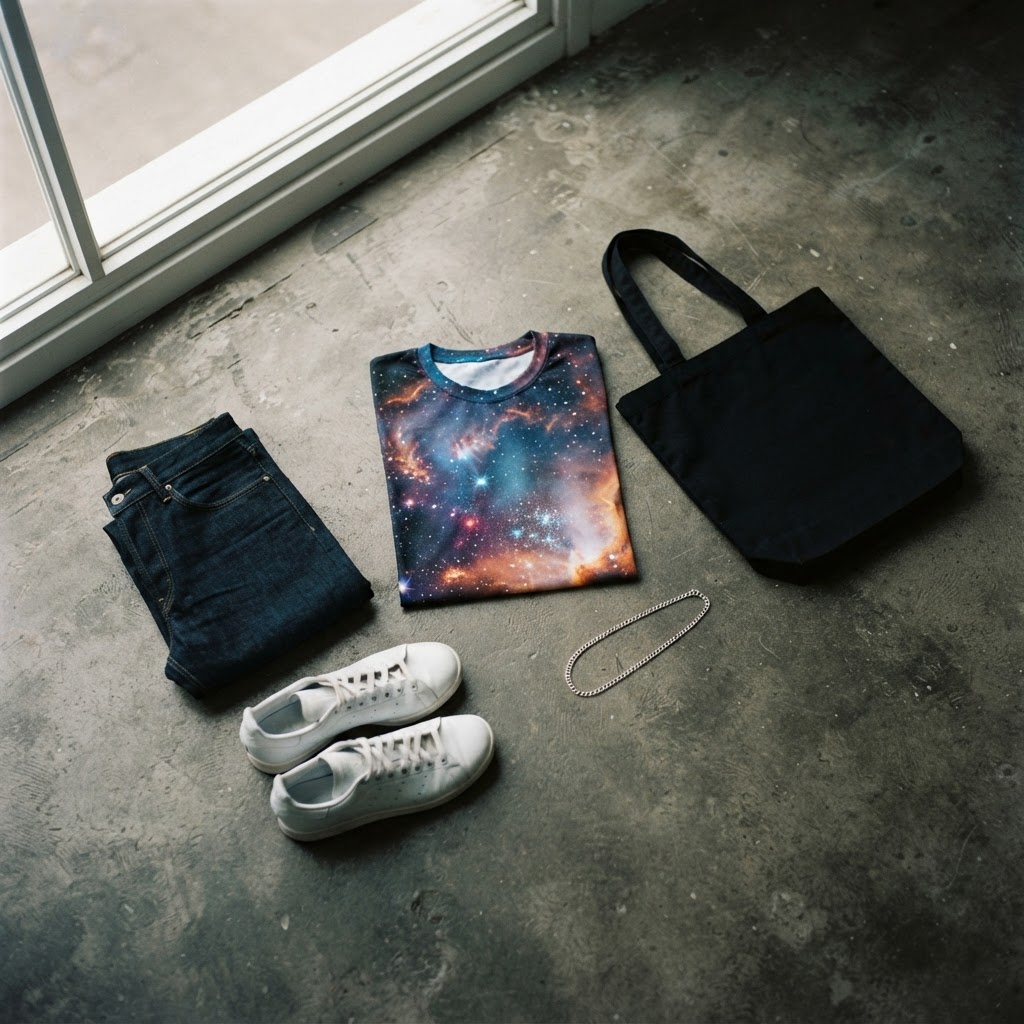
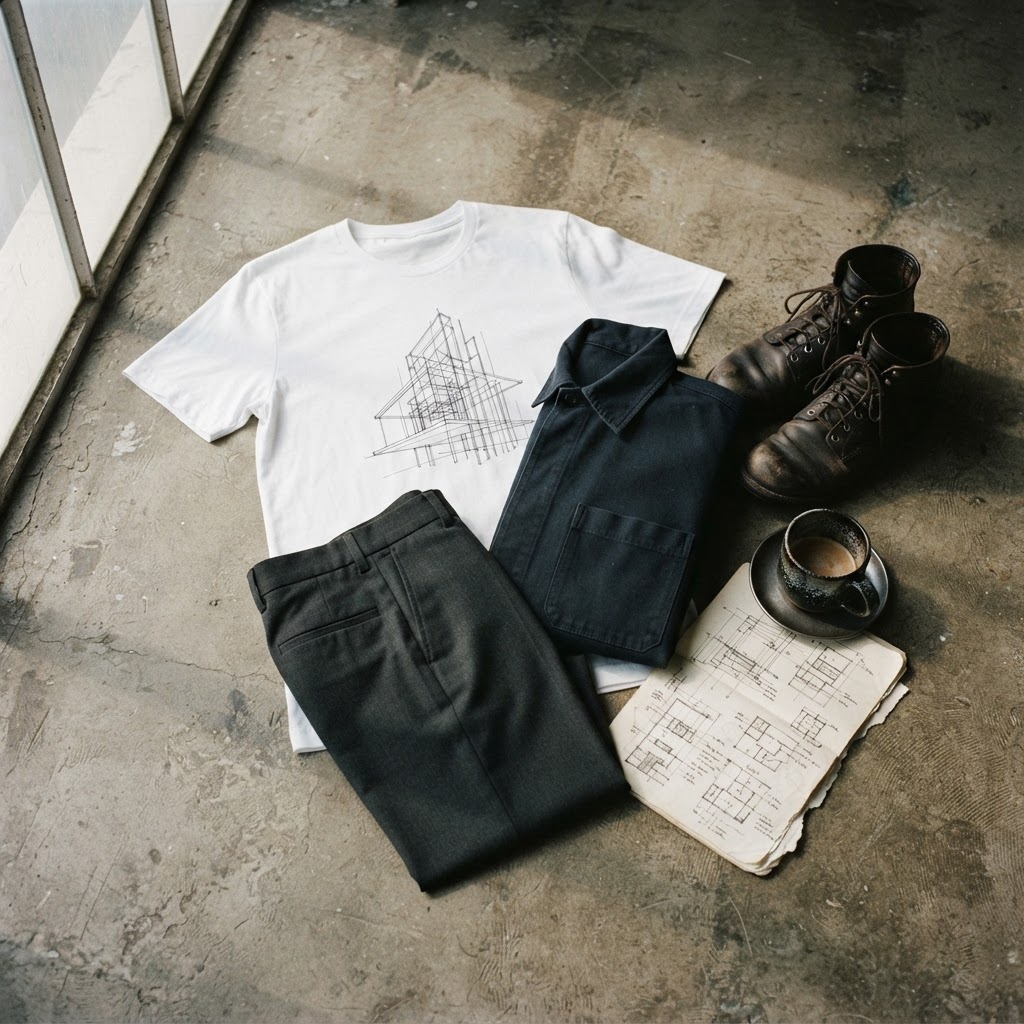
The most direct way to wear a minimal line-design tee is to commit to simplicity across the whole outfit. This isn't laziness — it's a choice to let the graphic do the only interesting visual work while everything else recedes cleanly.
Start with a well-fitting pair of straight-leg trousers in a neutral — black, ecru, stone, or a warm grey. Not tapered to the point of stiffness, not wide enough to shift the silhouette's centre of gravity. The tee should be either tucked half-in or left out depending on its length, but the proportions matter: if the tee runs long, it needs a slimmer trouser to balance. If it's cropped or standard length, there's more flexibility.
Footwear in this context should be unfussy. A low-profile trainer — clean, preferably single-material — or a plain leather shoe if you're pushing the outfit toward something smarter. The goal is to remove as many competing decisions as possible so the viewer's eye lands on the graphic and stays there.
This approach works especially well with line-work designs because the illustration doesn't bleed into the rest of the outfit — it sits contained, almost like a print hung in a room with plain walls. The Apache Warrior design carries that quality. The linework is dense enough to reward attention but clean enough to breathe in open space.
Two: The Layered Contrast
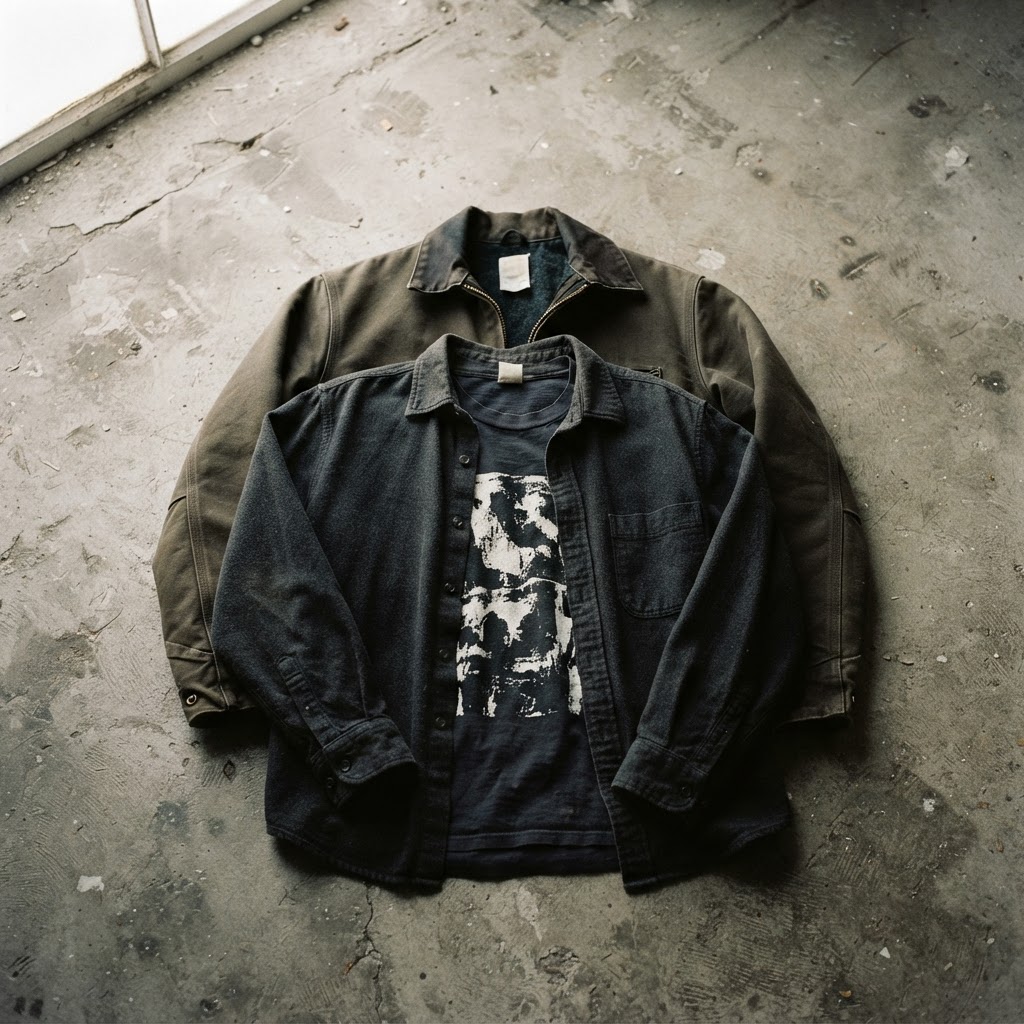
The second approach introduces texture and weight through layering, using the line-design tee as the visible interior layer against something with more physical presence.
An unbuttoned overshirt in a heavier fabric — brushed cotton, lightweight canvas, or a coarse linen — works well here. The key is leaving it open wide enough that the graphic on the tee is fully legible. There's no point in layering a considered graphic under something that swallows it. The outer layer should frame the tee, not compete with it.
Colour contrast is where this gets interesting. If the tee is on a white or off-white ground with dark line work, try an outer layer in a deep shade — navy, forest green, or a washed black. The tee becomes a bright interior note, the graphic popping against the contrast. If the tee runs on a darker ground, reverse the logic: a lighter overshirt or jacket lets the tee read clearly without disappearing into shadow.
Trouser choice here can afford to be slightly more textured — a cargo pant with minimal hardware, a wide-leg chino, something with a little more presence. Because the outfit has more layers competing for attention, you need stronger shapes to balance the composition.
The line-design tee in this context stops being just a tee. It becomes part of a layered visual system, and the restraint of the graphic — the fact that it doesn't try to fill every available space — is what allows it to sit harmoniously inside a more complex outfit.
Three: The Dressed Tension
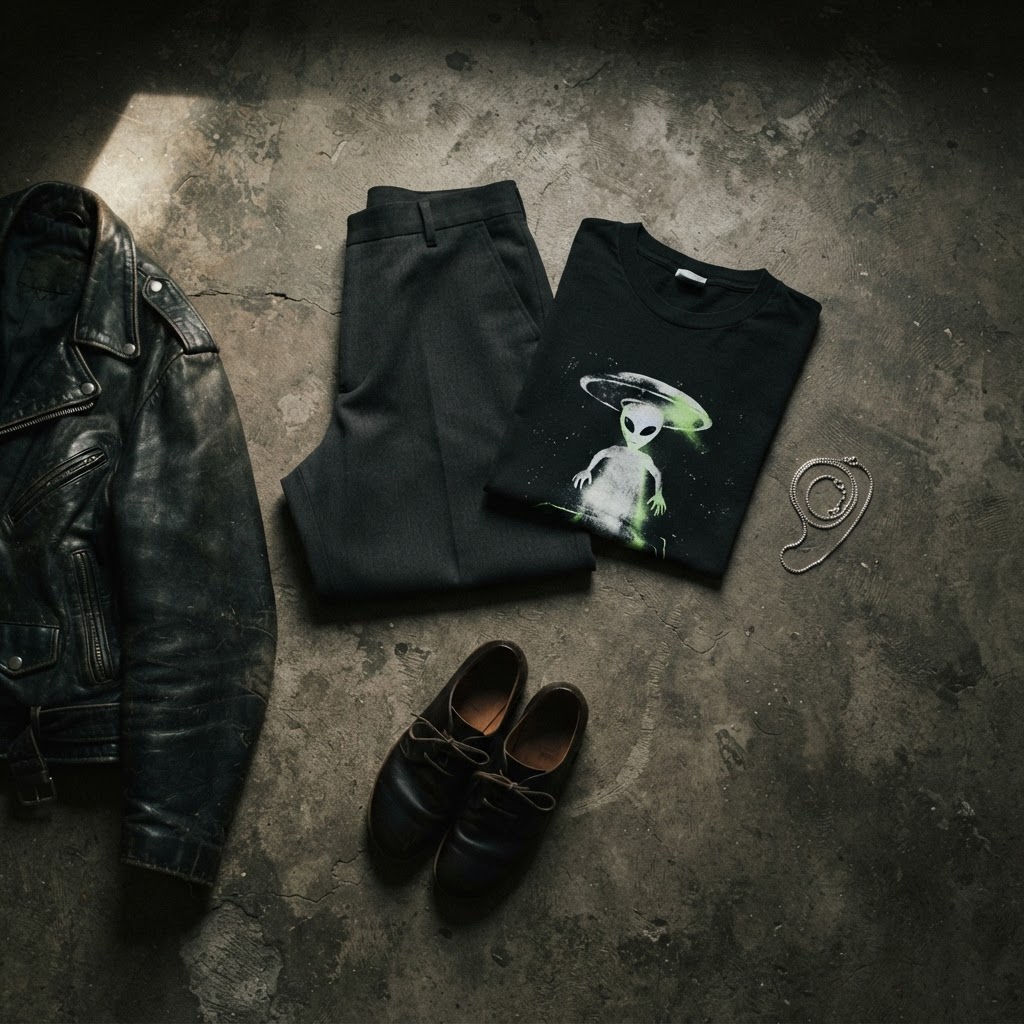
This is the approach that gets the most scepticism and produces the most interesting results: treating the graphic tee as a serious piece within an outfit that has no business being casual.
Tailoring and graphic tees have a long, productive friction. The graphic tee introduces instability into a formal structure — it signals that the wearer understands the rules well enough to break them deliberately. But this only works when the graphic is strong enough to justify the disruption, and when the rest of the tailoring is impeccable enough to make the disruption legible as a choice rather than an accident.
A tee with minimal, controlled line work is better suited to this than a maximalist print. The graphic has weight and seriousness; it doesn't read as juvenile against a well-cut trouser and a structured blazer. Wear it tucked into high-waisted tailored trousers — slim or pleated both work, depending on the decade of tailoring you're referencing — with a single-button blazer or a structured overjacket.
Shoes should be proper: a clean leather boot, a pointed derby, or a minimalist loafer. Nothing sporty. The point is to hold the formal structure of the outfit at a high enough level that the graphic tee reads as the deliberate break it is.
With a warrior-figure illustration — strong, figurative, built from deliberate lines — this approach takes on an additional edge. There's something in the iconography that sits interestingly against the language of tailoring: the idea of ceremonial dress, of adornment as identity, read through two very different visual traditions simultaneously.
What the Design Is Actually Doing
It's worth pausing on why line work specifically lends itself to versatile styling. Filled, high-contrast graphic tees — the kind built around solid blocks of colour or complex photographic prints — anchor the outfit's visual weight at the chest. They're bold, they're deliberate, and styling them requires building around that anchor.
Line work operates differently. Because the design is built from negative space as much as from positive mark-making, it integrates more fluidly with the fabric beneath it and the garments around it. The eye reads the graphic, but the graphic doesn't stop the outfit. It participates in it.
This is why a well-drawn line illustration can live inside three completely different outfit contexts — clean stack, layered contrast, dressed tension — and feel native to all three. The graphic is strong, but it isn't domineering. That balance is genuinely difficult to achieve in design, and it's the thing that separates a considered piece from a tee that only works in one context.
A Note on Fit and Fabric
None of the above styling approaches work if the tee itself doesn't fit properly. A minimal line-design tee with a poor fit doesn't look restrained — it looks unintentional, and unintentional is the one thing you can't recover from in this kind of outfit construction.
For the clean stack and dressed tension approaches, a fitted or regular cut that sits at or just below the waistband is ideal. For the layered contrast approach, there's slightly more latitude — a tee with a touch more ease sits better under an overshirt without bunching.
Fabric weight matters too. A heavier cotton holds its shape and drapes with more presence; lighter cotton is fine for summer but loses some of the visual solidity that makes line-work graphics read well at a distance. The difference between a 180gsm tee and a 220gsm one is small in your hand and significant on the body.
The Broader Principle
What these three styling routes share is a respect for the design itself. The worst thing you can do with a tee that has genuine graphic intelligence is dress it in a way that apologises for it — burying it under layers, pairing it with chaotic pattern, or surrounding it with so much going on that the design becomes background noise.
Line work rewards attention. Give it the space to receive it, and the outfit builds itself around that quality. The Apache Warrior design at T49 carries that kind of intentional restraint — the figure is powerful, the line work is controlled, and the graphic is built to be looked at properly rather than glanced past. That's where the styling conversation starts.
The Apache Warrior Unisex t-shirt is available now in the T49 collection at /product/453549291. EXPLORE THE COLLECTION →